
What Cage Should I Get? Screen or Hybrid for Your Chameleon
By Bill Strand, chameleon keeper, host of the Chameleon Academy podcast, and designer of Dragon Strand cages.
The short answer
Choose your cage for the room your chameleon will live in, not the weather outside. Measure the humidity in that room, day and night. If it’s already within about ten points of what your chameleon needs, a screen cage can work well. If it’s well below that, and in most homes with heating or air conditioning it is, a hybrid cage gives you the control you need.

Listen to this
Dragon Strand Podcast, Episode 1: What Cage Should I Get? · 25 min
Prefer your phone? Every episode is free in the Chameleon Academy app. All Dragon Strand Podcast episodes
The rule of thumb: measure the room, then choose
Your chameleon doesn’t live in the weather report on your phone. It lives in the room where you put the cage. So the test is simple, and you can run it yourself before you buy anything.
- Put a thermometer and a humidity meter in the room where the cage will go.
- Read them during the day and at night, including while the heat or air conditioning is running.
- Compare both readings with your chameleon’s targets. For panther and veiled chameleons, the Chameleon Academy care guides often aim for around 50% humidity during the day and higher at night, often 80 to 100%. Those are examples; follow the guidance for your species.
| Your room’s humidity (day and night) | Cage |
|---|---|
| Within about 10 points of your targets | A screen cage can work |
| Well below your targets (most heated or air-conditioned homes) | Hybrid |
| Don’t know yet | Measure first; start by looking at hybrid |
A worked example. You keep a panther chameleon. Your targets are about 50% by day and 80 to 100% at night. Your room reads 40% in the afternoon: that’s within ten points, so daytime is fine. At night, with the heat on, it reads 45%: that’s 35 points or more below your night target. The room fails the night test, so a hybrid cage is the better tool.
“Wait. By that test, almost no one should use a screen cage.”
Look at the night reading and you’ll see it: most houses can’t get within ten points of 80% humidity at night. So yes, most homes fail this test, and that’s exactly why, in most cases, a hybrid cage is the right cage for a chameleon. There are exceptions. I have a friend in Louisiana who has to run dehumidifiers, and her home is an appropriate place for a screen cage.
So why do so many people still say chameleons need screen cages? It comes from our past. That sound bite comes from the same era as another one: that chameleons are always thirsty. The two are connected. Screen cages have been used for decades, and they still can be. But we’ve learned much more about chameleon husbandry since then, and hydration is the reason a screen cage isn’t the ideal solution in most indoor homes.
Already have a screen cage? Turn it into a hybrid
Don’t panic, and don’t throw it away. Owning a screen cage doesn’t mean you made a bad decision. Run the room test above first. If you’re close to your targets, you may be fine. If you’re well below, you can turn the screen cage you already have into a hybrid, quickly and cheaply.

What you need: a shrink film window insulation kit (thin plastic film plus double-sided tape, sold very inexpensively online and at hardware stores) and a hair dryer.
- Line the aluminum frame of each panel with the kit’s double-sided tape. The film goes on the frame, not the screen.
- Lay the film across the tape, carefully.
- Shrink it tight with the hair dryer. The film tightens when it’s heated.
- Cover the sides, the back and most of the front. Leave the screen top open, and leave a 1-inch strip open across the bottom of the front.
That low strip is what keeps the air moving. Cool air comes in at the bottom of the front, warms under the lights, rises and leaves through the screen top, and pulls fresh air in behind it. That’s the chimney effect. It isn’t as pretty as a cage designed to do the job, but it works. You can also use PVC panels or heavy plastic sheeting the same way.
Covering only the back is mist control, not humidity control. To hold humidity you need all four sides, with that low front vent. The table further down shows why.
Screen vs hybrid: the real difference is control
A screen cage lets the air inside trade places with the room very quickly. A hybrid cage slows that exchange down, so you can hold the conditions your chameleon needs inside the cage.
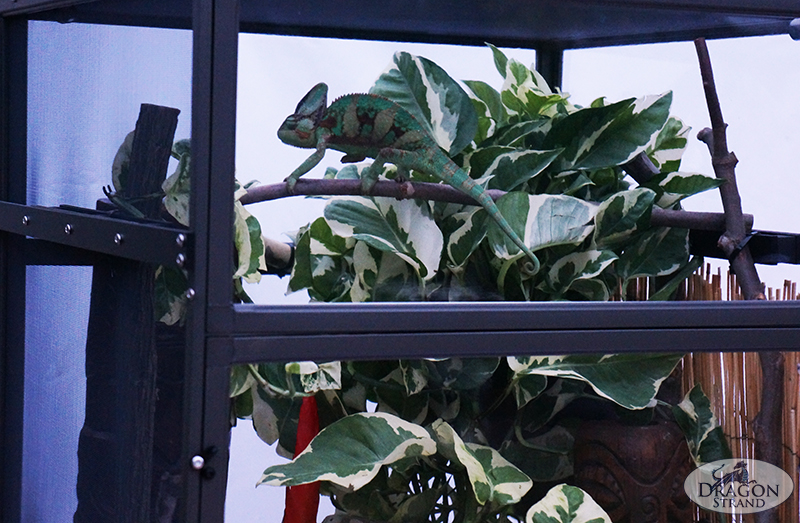
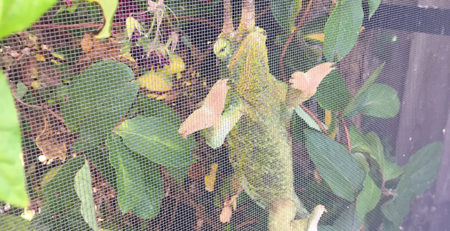
That free exchange is fine when the room already has the conditions you want. But in winter the heat runs and the house dries out, and in warm places the air conditioning runs all day. Put a screen cage in a dry room and the air inside swaps with that dry air almost immediately. You can mist, offer drinking opportunities and use good nighttime humidity techniques, but you’re fighting the whole room.
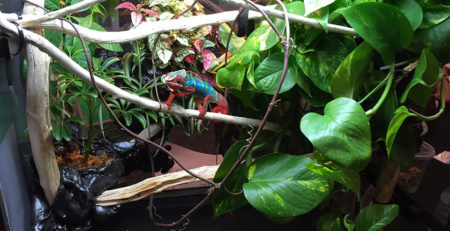
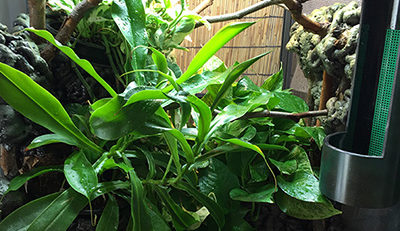
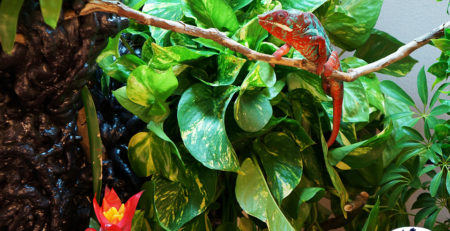
A hybrid cage has solid sides, a screen top and a low ventilation opening at the front. You still get air exchange through the chimney effect, just not the rapid swap with the room. So when you mist, the humidity stays long enough to make a difference. You aren’t sealing your chameleon in a humid box; you’re giving yourself control over the microclimate, and it doesn’t vanish the moment you stop adding heat or water. With a screen cage, you’re really trying to change the humidity of the whole room. With a hybrid, you control the inside of the cage and leave the house alone.
How screen cages became the standard
In the 1970s and ’80s, when chameleons were becoming more available, aquariums were what we used for reptiles, and chameleons didn’t do well in them. People tried bird cages, free-roaming rooms and fences around backyard trees, and eventually moved to screen cages. That was a real step forward.
Some of the most successful keepers of the ’80s and early ’90s used large outdoor screen enclosures here in Southern California, where Jackson’s chameleons did very well. Those keepers shaped the early chameleon community, the Chameleon Information Network grew out of it, and the idea that chameleons need screen cages spread well beyond California.
The results were genuinely better, but several things changed at once: far more space than a forty-gallon aquarium, more natural temperatures (we had been keeping high-altitude species like Jackson’s far too warm), and more fresh air. It was easy to look at the screen and decide ventilation was the answer. Outdoors in Southern California, it was a very good answer. Inside a house in Ohio in winter, it isn’t.
By 2002, keepers in colder climates were already writing about solid-sided enclosures, but the screen cage had become the accepted answer, and it was what you found in stores. I started Dragon Strand in 2013 because I wanted hybrid cages designed specifically for chameleons. My first product line was entirely hybrid; screen cages came later, and I’ve made both ever since.
Do chameleons need ventilation?
Yes, absolutely. The question isn’t whether a chameleon needs air exchange; it’s how much suits the cage and the room around it. A hybrid cage isn’t airtight. The screen top and low vent are there for air exchange, and the chimney effect keeps air moving. We’re slowing the exchange enough to control humidity, not stopping it.
Solid sides don’t cause respiratory infections. Stagnant air is the problem.
Solid sides, whether glass, PVC or wood, aren’t the issue. A well-designed hybrid keeps the air moving. And the goal isn’t 100% humidity all day. It’s a cycle: wetter at night, drying out during the day, with air moving the whole time. The cage is the tool that lets you carry out whichever cycle you choose.
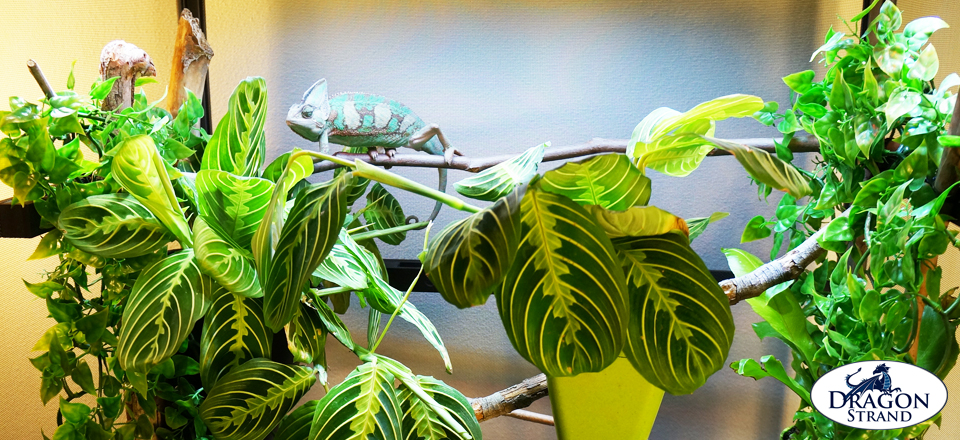
How many solid sides does a chameleon cage need?
For a standard 4-foot-tall cage, 2 or 4 feet wide, housing an adult panther chameleon:
| Solid sides | Humidity it holds | Good for |
|---|---|---|
| 1 (the back) | Almost none | Keeping mist off the wall |
| 2 (a corner) | A little, in that corner | A planted corner microclimate |
| 3 (sides and back) | A little more, for a little while | Misting without wetting furniture |
| 4 (with a low front vent) | Noticeable: the jump | Holding humidity in a dry room |
Here’s the part that surprises people: solid sides don’t add up. Close one side and you don’t get a quarter of the humidity control. You get almost none. Two sides give you a little, in one corner. Three give you a little more, for a little while. Then the fourth side closes and the cage suddenly starts holding humidity. It isn’t a ramp where each side adds its share; it’s a jump at four. That’s why closing one or two sides “to help with humidity” rarely does much: until all four are solid, the air inside keeps trading places with the room.
How much humidity the cage holds as you add solid sides
Almost none
A little, in a corner
A little more, briefly
The jump
An illustration of the pattern for a 4-foot cage and an adult panther chameleon, not measured values.
At four sides you also need a low vent at the front so the air keeps moving. On a 4-foot cage, the bottom is far enough from the screen top that air could stagnate there without it. The vent can be surprisingly small: if you’re wrapping your own cage, a 1-inch strip across the bottom of the front is more than enough.
Hatchlings and tiny species can use microclimates as small as a potted plant, so don’t treat these as absolutes. They’re for the chameleons most people keep.
Is a glass cage bad for a chameleon?
No. Glass doesn’t cause respiratory infections, and you can be very successful keeping chameleons in glass cages, as long as they have ventilation ports, and most do. The problem with glass is size: glass cages are heavy, breakable and expensive to ship, so it’s hard to find them large enough for the chameleons most people keep. Cages that mix a glass panel or two in with screen panels behave like the one-to-three-side rows above: they don’t change the ventilation enough to count on.
How I design Dragon Strand cages
Everything above shaped my own designs. The Tall Screen cage has a solid back to keep mist off your wall, and three screen sides for ventilation. The Tall Hybrid (2 × 2 × 4 ft) and the Large Hybrid Atrium (4 × 2 × 4 ft) have PVC back and sides and an acrylic door, with a screen panel under the door for the chimney effect. That panel is sized to suit as many rooms as possible, and you’re welcome to block more of it if you want more humidity.

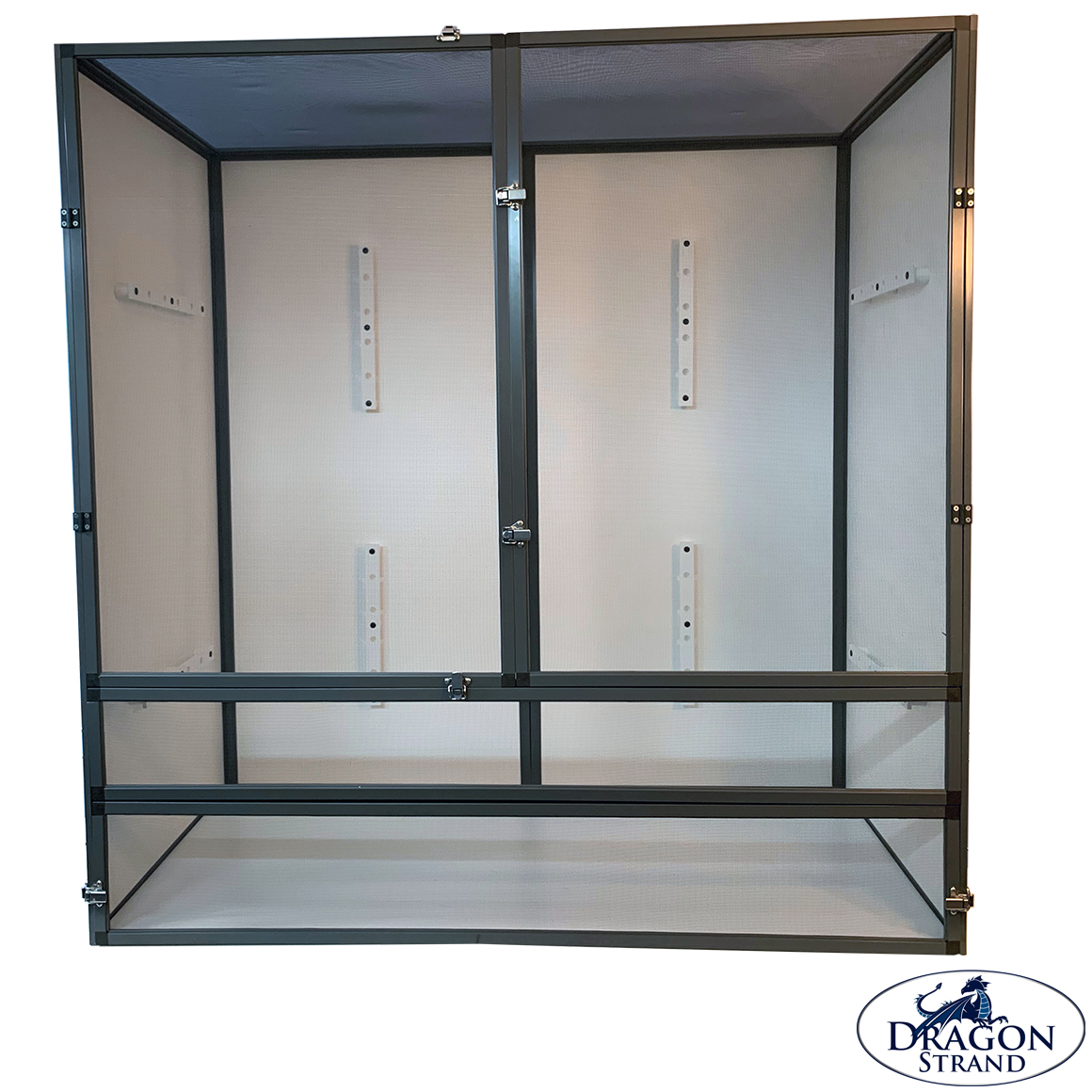
People still call me worried about ventilation in a hybrid, which shows how strong the old screen-cage sound bite still is. For indoor use, these hybrids have more than enough ventilation for most situations. I wouldn’t put them outdoors in full sun.
Questions people ask
Is a screen cage okay for a chameleon?
Yes, if the room it’s in stays within about ten points of your chameleon’s humidity targets, day and night. Outdoors, where local conditions suit your species, screen cages shine. In most heated or air-conditioned homes, a hybrid gives you more control.
What size cage does a chameleon need?
For an adult panther or veiled chameleon, 2 × 2 × 4 feet is the usual minimum, and bigger is better.
Do solid sides cause respiratory infections?
No. Stagnant air is the problem, not solid sides. A hybrid with a screen top and a low front vent keeps air moving.
How many sides of a screen cage should I cover?
For mist control, just the back. For humidity control, all four: the sides, the back and most of the front, leaving a 1-inch strip open across the bottom of the front. Fewer than four sides holds very little.
How do I make my screen cage hold humidity?
Cover the sides, back and most of the front with shrink film window insulation on the frame, and leave the screen top and a low front vent open. Steps are above.
Is a Reptibreeze good for a chameleon?
It’s a screen cage, so the same room test applies, and many keepers start with one. If your room is well below your targets, you can turn it into a hybrid with shrink film the same way.
Should humidity be 100% all the time?
No. Aim for a cycle: wetter at night, drying out during the day, with air moving throughout.
Can a hybrid cage go outside?
Not in full sun. Outdoors, where conditions suit your species, a screen cage is usually the better choice.
Go deeper with other chameleon keepers
This episode is part of a free series in the Chameleon Academy app, with step-by-step guides for setting it all up, a new show every day, and care guides for each species.
Download on theApp Store Get it onGoogle PlayFree on iPhone and Android. No account needed.
About the author. Bill Strand has kept chameleons for many decades. He hosts the Chameleon Academy podcast, leads natural history expeditions to Madagascar, and has designed Dragon Strand’s screen and hybrid chameleon cages since 2013. Bill Strand runs Chameleon Academy and designs Dragon Strand cages.







Leave a Reply
You must be logged in to post a comment.